
StarFish, or Asterias in Greek.
The Greek word «Asteri» means «Star».
When looking at the Scientific Classification of the Starfish you notice that it belongs to the Class of «Asteroidea» and to the Subphylum of «Asterozoa», which in Greek means Star-shaped (astero) Animals (zoa).
The Starfish or sea stars are star-shaped echinoderms. About 1,500 species of them can be found on the seabed across the world, from the tropical Indian ocean to the polar waters of Antartica. While they don’t mind the water temperature they also don’t seem to mind the water depth as well, since they appear on the intertidal zone but they also travel far more deeper, all the way down to abyssal depths, more than 6,000 meters below the surface.
Being a marine invertebrate, since neither possesses nor develops a vertebral column (i.e. backbone or spine), a typical starfish has a central disk and five arms – though, some species have a larger number of arms. The upper surface of a starfish may be smooth, granular or spiny and is covered with overlapping plates.
Starfish, alike stars, likes to shine, so most species are brightly colored in various shades of vivid red or orange, blue and green, while the more modest ones are grey or brown.
Despite their gentle looks, starfish are mostly predators and they feed on benthic invertebrates. The most voracious predator, the crown-of-thorns starfish, one of the largest sea stars in the world, is a large, multiple-armed starfish, which received its name from the venomous thorn-like spines than cover its upper surface, resembling the Biblical crown of thorns. Being most common in Australia, it preys upon hard, or stony coral polyps, throughout the Indo-Pacific Region and is considered to be one of the world’s 100 worst invasive species!
A special thing that others may be jealous at is the complex life cycles of the starfish. Apart from the fact that starfish can reproduce both sexually and asexually, most of them can actually regenerate damaged parts or lost arms, while they can shed arms as a means of defense. What is more, some species can not only regrow an entire new limb, but they can regrow a complete new disc from a single arm!
Starfish are salt water lovers! Although starfish say «yes» both to warm and cold ocean waters, they say «no» to any freshwater habitats. And that is because starfish, like all Echinoderms, maintain a delicate internal electrolyte balance that is in equilibrium with sea water. So, while you can find a starfish in all the world’s oceans, in coral reefs, rocky shores, seagrass, sand or even mud, you will not find them away from salt water.
While starfish are great predators themselves, they also consist a great delicacy for tritons, crabs, fish, gulls, sea otters and also other starfish ! Thus, in order to defense themselves, they have saponins in their body walls, which give a really unpleasant flavors to potential eaters. Some even include powerful toxins on their body, or develop an armor of spines and hard plates.
Robert Paine in 1966 used first the term «keystone species» for starfish to underline their ecological importance. He found in his research that one starfish species, Pisaster ochraceus, was a major factor in the diversity of species in the intertidal coasts of Washington State. When he experimentally removed this top predator from a stretch of shoreline, this resulted in lower species diversity, mainly caused by the Mytilus Mussels domination, which were able to outcompete other organisms for space and resources.
After Paine, many more researchers conducted similar tests and experiments, which all reached similar conclusions: Starfish can regulate the diversity, the distribution and the abundance of microorganisms!
But, in order to balance the starfish’s impact on ecosystems we also have to note the negative effects that they may have on them. Outbreaks of crown-of-thorns starfish have caused serious damage to coral reefs in Australia and French Polynesia. Especially in the latter, a study in 2006 has shown that due to the arrival of this migratory starfish the coral cover declined significantly ( dropped from 50% to 5% in 3 years). Also, another invasive species, the Asterias amurensis, managed to arrive to Tasmania from central Japan, and grown in numbers that much as to threaten commercially important bivalve (marine molluscs) populations.
What is our relation with the starfish? Well, we do not eat them that much – apart from China and Indonesia sometimes- mainly because of their bony ossicles, their saponins but also because of the toxins (tetrodotoxin) that some species have. Some species that prey on bivalve mollusks can even transmit paralytic shellfish poisoning.
What we like more perhaps, is to sell and buy them as souvenirs, which is particularly bad. Because starfish are relatively easy to collect, we managed to reduce the numbers of some species severely and we even managed to make some of them like the Oleaster reticulatus, an endangered species. The collection of this species is illegal, but, unfortunately, it is still being sold.
So, perhaps we need to ask ourselves, is it better to have a dead starfish inside a vase – which is highly likely to forget its existence after a month – or to admire an alive starfish, full of color and life underwater, in its natural habitat?
Dead stars create no smiles! At the other hand, check your face while you are seeing one underwater ! And, yeah, pics are harmless and for free 😉 Even a ton of them!
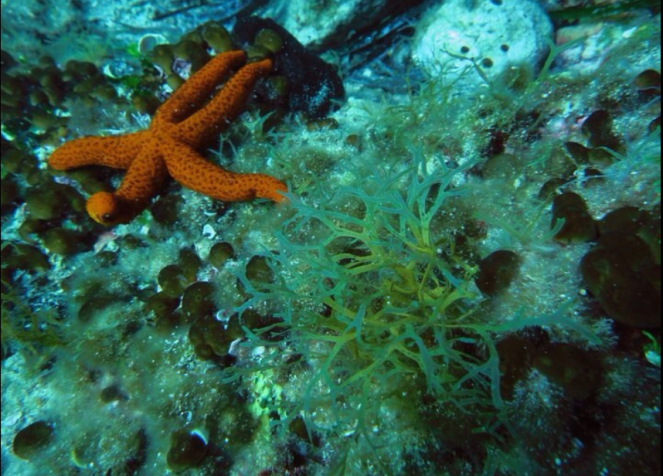
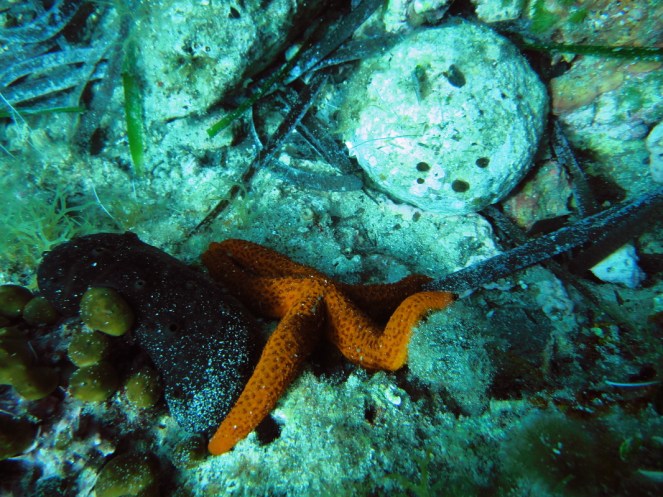
Below you can view various pictures, taken during my research, of starfish species living in the Mediterranean Sea, in the Aegean Sea and mostly in Halkidiki region (northern Greece). Enjoy!

*sources:
https://en.wikipedia.org/wiki/Starfish
https://en.wikipedia.org/wiki/Marine_invertebrates
https://en.wikipedia.org/wiki/Invertebrate
https://en.wikipedia.org/wiki/Crown-of-thorns_starfish
https://en.wikipedia.org/wiki/Bivalvia
 _blue goldfish